Before surgery essentials
Preparing for surgery
Upcoming surgery can feel daunting, but we are here to walk you through it! The office will handle scheduling and insurance authorization for surgery, but we need your help too, especially with coordinating your medical doctor and planning for extra help you will need at home.
The preoperative instructions below are meant to give you a general idea of what to expect, but each case is unique. If you have any concerns or questions, please reach out to our medical team.
Our surgery centers and operating locations are:
Irvine- Sand Canyon Surgery Center
6640 Alton Parkway
MOB1, 2nd floor
Irvine, CA 92618Saddleback Surgery Center
24411 Health Center Dr.
Laguna Hills, CA 92653
Laguna Niguel Surgery Center
27882 Forbes Rd
Laguna Niguel, CA 92677
Preoperative Instructions
If you are scheduled for surgery, please read these instructions carefully and contact your doctor’s office if you have any questions or concerns.
You will receive details of your surgery time and when to show up on the Day Before Surgery
-
If you have any major medical problems, you will require a note of medical clearance from your primary care doctor. This must be done within 30 days of surgery and faxed to our office. We may also ask you to meet with our anesthesiology team to help create a personalized anesthesia plan in advance.
-
If you smoke or otherwise use nicotine (tobacco, e-cigarettes, nicotine patches, etc), let your doctor know. For your own safety, you should stop before surgery. Nicotine IN ANY DOSE (even one cigarette a day) increases your risk for infection and the risk that your bones and/or skin will not heal. Additional information about smoking cessation can be found at the National Quit line: (800) 784-8669.
-
If you take blood thinners (aspirin, Plavix/clopidogrel, Coumadin/warfarin, Xarelto, etc), please let your surgeon know. These medications increase bleeding and typically need to be stopped before elective surgery. We will help to do so safely.
Unless you have an acute injury or fracture, please avoid any anti-inflammatory medications (ibuprofen/Advil/Motrin, naproxen/Aleve, etc) in the 7 days before surgery because they can increase bleeding. Also stop taking any vitamins or supplements for the same reason. Vitamin D is ok to keep taking.
Birth control pills may increase your risk for blood clots after surgery. If you are taking birth control pills or other hormone supplementation, you should stop 2 weeks before surgery if possible. If you cannot stop it, you will need a stronger blood thinner after surgery.
-
If you have any cuts around your foot/ankle before surgery, let us know! If you have an infection, your surgery may need to be postponed and you may need antibiotic treatment.
-
Arrange escort home: you will need an adult to take you home after surgery. You cannot leave the surgery center alone in You will also need transportation to your postoperative visits until you are able to drive.
Plan for help at home: Arrange for someone to stay with you at home or to be available for at least 48 hours to assist you with daily activities. You should ask Dr. An about driving after surgery as some patients may be restricted for 2 weeks and others up to 3 months, depending on the type of surgery and what foot is operated on.
Post-op rehab devices: Plan ahead… know how you are going to get around after surgery as you most likely will not be able to put weight on the operative leg. Practice if you can! You should understand your expectations and limitations. Only crutches can be provided on the day of surgery, so if you will need anything else, get it before surgery.
*If you have other orthopedic problems and worry about getting around, ask about formal training with Physical Therapy prior to your surgery.
Day of surgery
Bring the following with you to the hospital
Health insurance card
One form of legal identification
Prescription medication card
One credit card
Any assistive device you have for after surgery, such as cane, crutches, walker, braces, etc.
A small bag for your belongings
A book, magazines, or music for relaxation
List of medications and doses
Telephone number where you can be reached after discharge
If you have sleep apnea, bring your mask attachment and a record of the settings you normally use. Please do not bring the CPAP machine, just the mask attachment. Patients with sleep apnea are generally required to stay overnight in the hospital to be monitored and observed.
Do not wear/bring any rings or jewelry

How will I walk?
The great majority of patients after foot and ankle surgery have to be non-weightbearing. Please review these videos before your surgery and practice in advance if you can!
Our orthopedic office can provide you with a walker or crutches, adjusted to your appropriate height.
Knee scooters are typically purchased out of pocket and available for order on Amazon.com
Non-weightbearing walking with Crutches
Using crutches to swing through each step, the operative foot (left) never touches the ground. Your arms should be bent by 5-10 degrees. Your weight should not rest on your armpits.
Partial weightbearing walking with Crutches
When your doctor allows you to put partial weight on the foot, make sure to still use crutches. The operative foot (left) and the crutches move forward together with each step so the weight is shared. You can self-adjust the amount of pressure through your foot versus through your arms.
Partial weightbearing with Walker
How to use a front wheeled walker for partial weightbearing. The operative/injured foot (right) and the walker move forward together with each step. Use your arms to offload your body weight. Make sure your walker is adjusted to the appropriate height, which allows you to stand tall and keep your elbows in a straight position.
Knee scooter
The knee scooter is a great tool to stay non-weightbearing or cover longer distances. This is possible even immediately after surgery in a splint (soft cast) or in a boot. Take turns slow and watch out for bumps in the road.
Protecting you after surgery
-

Splint
A short leg splint is a soft cast, typically applied immediately after surgery. It is designed to immobilize and protect your foot and ankle. It's made of padding and plaster and is custom-fitted to your leg. There is extra room within the splint to allow for swelling.
It cannot be removed except by the doctor or orthopedic technicians. It must be kept clean and dry.
YOU MAY NOT WALK IN THE SPLINT.
Please notify your doctor’s office immediately if your splint becomes damaged or wet.
-
Cast
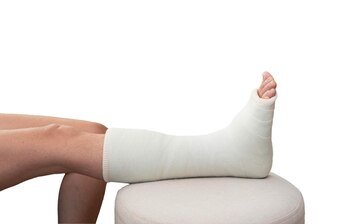
A cast is a rigid, protective shell that encases your foot and ankle. It's typically made of fiberglass and is custom-shaped. The cast provides excellent immobilization, but can be constricting and therefore not frequently used immediately after surgery. It cannot get wet. Do not insert objects to scratch inside the cast.
Watch for swelling and color changes to the toes in the cast. Purple or white toes and difficulty moving them can be a sign of a cast that is too tight. Please contact your doctor’s office immediately.
-

Boot
A Cam Walker Boot is a removable device designed to support and protect your foot and ankle. After surgery, this is usually the next step after the splint is removed.
The boot is removable. It offers mobility and support while allowing you to gradually start walking on your operated foot. Please follow your doctor’s instructions about how much weight you may apply on your foot in the boot.
It can be typically removed for showering and for sleep. You may be able to remove it for icing and stretching the surgical area.
General tips
Elevation while wearing your splint is key. It is not always possible to ice through the layers of padding. Keeping the foot near the same level as your heart is the best way to keep swelling under control.
When starting to walk in the boot, you will share the weight of your body between your foot and crutches/walker. Please see video on partial weightbearing. You may choose to wear a thicker-soled shoe or “Even-up” device on your other foot to feel balanced.
You may use ride a knee scooter to get around while in any of these devices.
What will I need?
-

Cast cover
After surgery, your splint or dressing cannot get wet. A commercial cast cover or other homemade devices (plastic trash bag, saran wrap) will be necessary.
-

Shower chair
A shower chair or other plastic patio chair will come in handy in the bathroom. Talk to your doctor about a prescription for this device.
-

Crutches
Crutches are the mainstay of support and balance after surgery. Many designs are commercially available. A walker is a good alternative if you don’t feel stable using crutches.
-

Walker
A walker, with wheels in front, can help you get around with less strain on the shoulders. However, it cannot be used on stairs or tight spaces. Talk to your doctor about a prescription.
-

Knee scooter
The knee scooter is excellent for traveling longer distances while keeping weight off your foot. These devices are not covered by insurance, but available from retailers from ~$140.